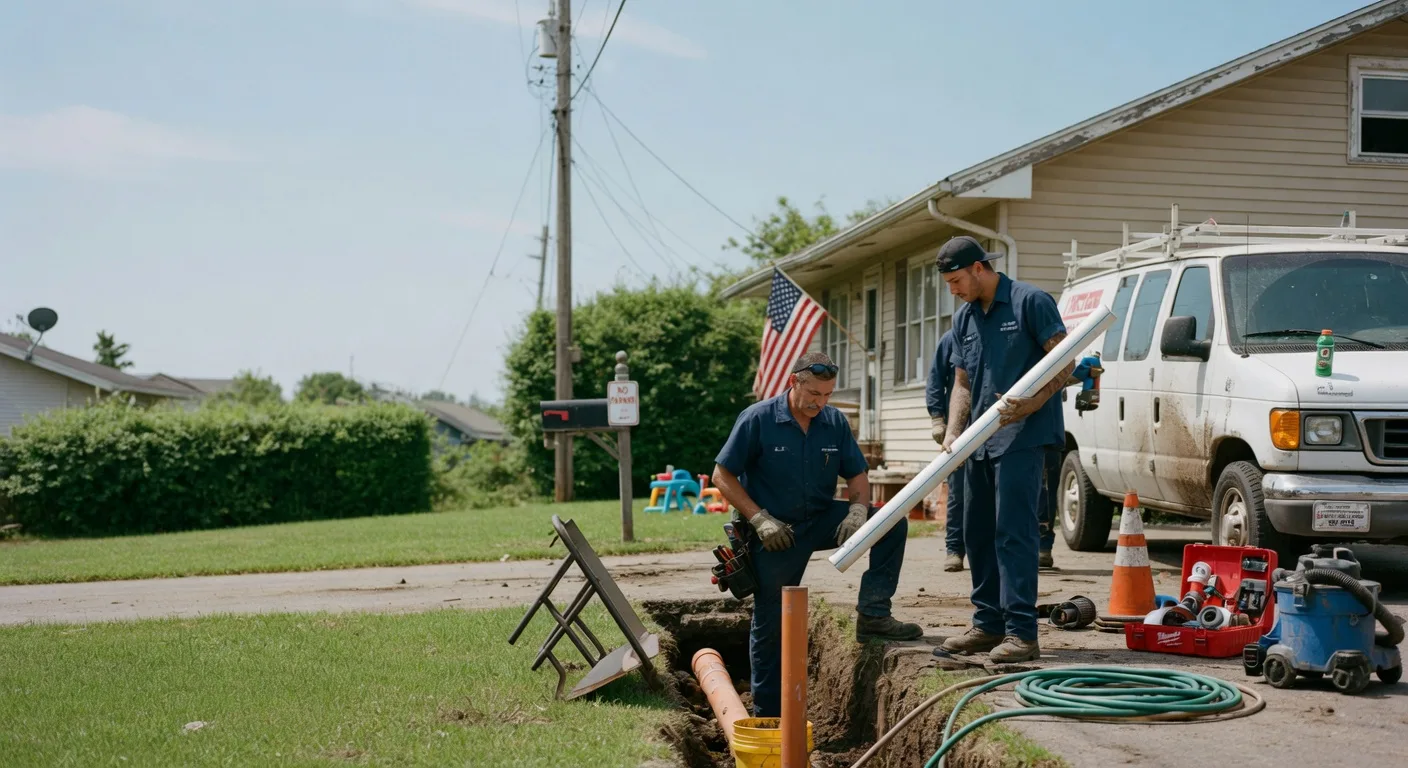
When is a drain backup a plumbing emergency?
Stop running water and call now if water is backing up from more than one drain, sewage is coming up through a floor drain or tub, a toilet overflows on its own, or you smell sewer gas inside the house. Those signs point to a blocked or failed main line. That is a different problem from one slow sink. The main line carries everything the house sends out, so when it stops, water has only one place to go, which is back up through the lowest opening in the house, usually a basement floor drain or a tub. Every load of laundry, dishwasher cycle, or shower adds to the flood, so turning off water use is the most useful thing you can do while you wait. Do not try to clear a full main line yourself; it takes a larger cable or a jetter, and sewage carries bacteria. Keep children and pets out of the affected area. A single slow drain that still empties, or a fixture that gurgles once in a while, can usually wait for a scheduled visit. A backup that is rising, spreading, or coming from several places cannot. Call (380) 262-9173 to be connected with an independent plumber in Linesville, PA.
If you decide the situation is serious, a few quick actions will limit the damage. Shut off the washing machine and dishwasher, and ask everyone to hold off on flushing. If water is already on the floor, lift rugs and move belongings out of the way, and keep electrical items and cords clear of wet areas. Do not run a wet vacuum on sewage, and do not wade through it barefoot. Take photos of the water and the affected fixtures, since they help if you later need to describe the problem to an insurer. Open a window for ventilation if the smell is strong. Know where your main water shutoff is, because if a supply line is leaking rather than a drain backing up, that valve is the right one to close. Older homes often have a floor drain that is the first place sewage appears, so check it first.
Why do my drains back up only when I run the washing machine?
When the washing machine drains and water comes up in the shower or a floor drain, the machine is rarely the problem. It dumps a lot of water in a short burst, and the line behind it cannot carry that volume away. Something is narrowing the pipe: grease and lint built up on the pipe wall, roots pushing in at a clay joint, or a bellied section that holds water and slows the flow.
Where it shows up tells you a lot. If only the laundry standpipe overflows, the blockage is probably in the branch line serving the machine, and a cable machine often clears that. If the lowest drains in the house gurgle or back up too, the blockage is further down, in the main line or a failed sewer lateral. That is a different job. It usually calls for hydro jetting or a camera inspection to see what is actually in there.
Safe homeowner checks: make sure the drain hose is not jammed tight into the standpipe, and try a smaller load. Do not keep running loads to see if it clears. Every cycle pushes more water toward the lowest opening in the house.
If water is coming up inside the house, stop using the washer, sinks and toilets and call. Expert Plumbers Co is a referral service, not a plumbing company. We refer you to a local plumber for Drain Cleaning in Linesville, PA: (380) 262-9173.
Watch for a pattern in when it happens, because that helps separate a drain problem from a venting or plumbing layout issue. If the backup always appears on the second or third load, the line is partly blocked and fills as the volume builds. If the washer is on a long run that ties into the main near a bathroom, the surge can push air and water into the nearest fixtures. Older homes often have laundry drains that were added later with a smaller pipe or an awkward connection, which cannot keep pace with a modern machine. A common mistake is placing a lint trap on the end of the drain hose and assuming it solves everything. It catches fibers, but it does not clear buildup already in the pipe. Tell the plumber the machine type and how many loads you run in a day.
Does a garbage disposal cause drain clogs?
Your kitchen sink is slow and there is a disposal under it, so you suspect the disposal. It can contribute, but the disposal itself is rarely the clog. It chops food into small pieces. It does not make that food disappear, and the pieces still have to travel down the pipe.
Ground scraps mix with grease and settle as grease build-up on the pipe wall, in the trap and in the horizontal run past it. Potato peels, rice, pasta, coffee grounds and fibrous stalks make it worse.
Safe homeowner checks: run cold water and listen for a hum, which means the disposal is jammed. Switch it off at the wall before anything else, and never put a hand inside. See whether the other side of a double sink fills, and whether the dishwasher drains.
Stop running water and call if other fixtures gurgle or back up, if you smell sewage, or if standing water does not drop for hours. One slow kitchen sink points to the branch line. Several fixtures affected points to the main line or a blocked vent stack.
A cable machine is usually enough for a soft clog near the trap. Heavy grease along a longer run calls for hydro jetting. A clog that returns calls for a camera inspection, to look for a bellied line.
Cost depends on access, how long the line is, and what has to be removed. For Drain Cleaning help, call (380) 262-9173. Expert Plumbers Co is a referral service and will refer you to a plumber serving Linesville, PA.
If you do keep a disposal, a few habits cut down on repeat clogs. Run a strong flow of cold water for about half a minute after each use, so the ground waste is carried past the trap and into the larger line instead of settling in the horizontal run. Scrape greasy pans into the trash first, and wipe them with a paper towel before they reach the sink. Citrus peel and ice do nothing for the pipe, so skip the habit of relying on them to clean it. Never use the disposal as a trash can for egg shells, bones, onion skins or artichoke leaves. Tell the plumber how old the unit is and whether the dishwasher drain hose connects to it, because a blocked disposal inlet can back dishwasher water into the machine. In older homes the kitchen line is often a long, shallow-sloped run, which is why grease collects there so easily.
Can a drain under a concrete slab be cleared without breaking the floor?
Usually, yes. Clearing a blockage and repairing a broken pipe are two different jobs, and only the second one needs the floor opened.
In a slab-on-grade house the drain lines run inside or beneath the concrete. There is no crawlspace to inspect, so symptoms are the only evidence you have. A cable or a hydro jetter still reaches the line through a cleanout or through a pulled toilet. Grease build-up on the pipe wall, roots in a joint and scale in cast iron can all be cleared that way.
What does need the floor opened is a cracked, collapsed or bellied section under the slab. A bellied line holds water and collects waste however often it is cleared. In older housing stock where clay or cast iron was the standard, failed sections are more likely.
A camera inspection with a locator pinpoints the fault. The plumber finds the exact spot and marks it on the floor before anything is cut, which keeps the opening small. What the job involves is driven by access, the materials, how much concrete must be opened and removed, and any permit or code requirement. Opening a slab often brings one in.
Safe homeowner check: note whether one fixture is slow or every drain is affected. A single slow fixture is usually a cable job on a branch line. Every drain backing up points to the main line or the sewer lateral.
Stop running water and call now if the whole house is backing up. Report water staining or a warm, damp patch on the floor, because it can mean a leak under the slab.
Expert Plumbers Co is a referral service. We refer homeowners in Linesville, PA to an independent local plumber. Call (380) 262-9173.
A spot repair under a slab is more disruption than most people picture. The plumber breaks out a section of concrete, digs down to the pipe, replaces the damaged length, and the floor is patched. Dust, noise and a few days without some fixtures are normal. Furniture and flooring over the area must be moved first, and tile or a finished floor may not match after patching.
For longer runs of damage, some plumbers can line the pipe from inside, or route a new line overhead or outside the house, which avoids cutting the slab. Whether either suits your pipe depends on its condition and on local code.
Ask to see the camera footage and the locator mark on the floor before any cutting begins. Mention in-floor heating, radiant tubing or a post-tension slab if you have one. Cutting into those without knowing is dangerous, so the plumber needs to hear about them before a saw comes out.
Since we put in a water softener, the floor drain or laundry drain backs up when it regenerates. Are they related?
The softener finishes its cycle and a minute later the laundry drain gurgles or the floor drain spits up gray water. You did not have this before, so it is fair to wonder if the softener caused it. In most cases it did not cause the clog. It exposed one.
During regeneration, a softener flushes brine and rinse water out through a drain hose, usually into a standpipe, laundry tub or floor drain. That water arrives in bursts, and the volume is sudden. If the drain line is clear, it carries the surge without trouble. If the line has a partial clog, such as grease build-up on the pipe wall, a root mat at a clay joint or a belly holding water, the burst is more than it can pass, and the water rises in the lowest drain.
The discharge also needs to be set up properly. Most plumbing codes require an air gap, a physical space between the end of the softener drain hose and the drain, so wastewater cannot siphon back into the softener. A hose pushed deep into a standpipe, or taped tight to it, can cause splashing and backflow of its own. Rules vary by area, so the installer or local building department can say what applies in Linesville, PA.
The key question is how widespread it is. If only the standpipe backs up, the trouble may be the standpipe, its trap or the softener hose. If the floor drain, laundry drain and a basement toilet all react, the main drain is partly blocked, and the softener is just the first thing to push it over the edge.
Safe homeowner check: look at where the softener hose ends. Make sure it sits above the drain with a visible gap and is not kinked or pushed down inside the pipe.
Stop running water and call now if sewage is coming up through the floor drain, if water is spreading across the floor, or if you smell sewage.
A cable machine is often enough for a soft clog in a short branch. If roots, a belly or grease are suspected, the work calls for a camera inspection and hydro jetting.
Expert Plumbers Co is a referral service. We connect you with an independent local plumber in Linesville, PA. Call (380) 262-9173.
Tell the plumber the problem started after the softener went in and when in the cycle it shows up. Ask them to check the air gap and the standpipe as well as the main. Scope depends on access to the line, parts for any standpipe or hose changes, how much has to be opened up if a section is damaged, and any code requirement.